
Interim management


When management gaps arise and quick decisions are required
Interim management is not an emergency solution, but an effective instrument for creating stability. You don’t have to spend weeks recruiting and nobody has to be trained for a long time.
Interim management is always important when a company needs leadership, structure and implementation strength at short notice. You may be familiar with this situation: a key person drops out, a project is stuck or a phase requires decisions that no one can take internally at the moment. In moments like these, you need someone who can take on responsibility immediately and give the company direction again.
Why interim management is a decisive success factor today
Gaps in leadership often arise from one day to the next. Resignations, illness or a change of manager leave teams without a clear direction. Without interim management, delays, uncertainties and inefficient processes quickly arise. An interim manager takes over immediately and creates structure before the company gets out of step.
Why transition phases become risky without experienced leadership
Transition phases show how stable an organization really is. If there is no leadership, processes slow down, decisions are left undone and projects come to a standstill. Interim management ensures that speed, clarity and implementation are not lost. A neutral manager brings calm to the situation and ensures that teams remain capable of acting.
How companies benefit from external experience in critical situations
An interim manager brings a perspective that is hardly possible internally. He is not bound by internal dependencies, sees things more clearly and makes decisions without delay. This objectivity is a decisive advantage, especially in restructuring, crises, transformations or M&A processes. The combination of experience, distance and competence makes interim management indispensable in many phases.

Four steps to cooperation:

1st request
You are welcome to send us your requirements at any time via e-mail or contact form and we will get back to you as soon as possible.

2. analysis
After an initial consultation, we analyze your requirements and check all available options to find the best solution for you.

3. consulting
In an individual consultation, we analyze your challenges and develop a tailored action plan together.

4. implementation
We support you throughout the entire project to ensure smooth implementation.
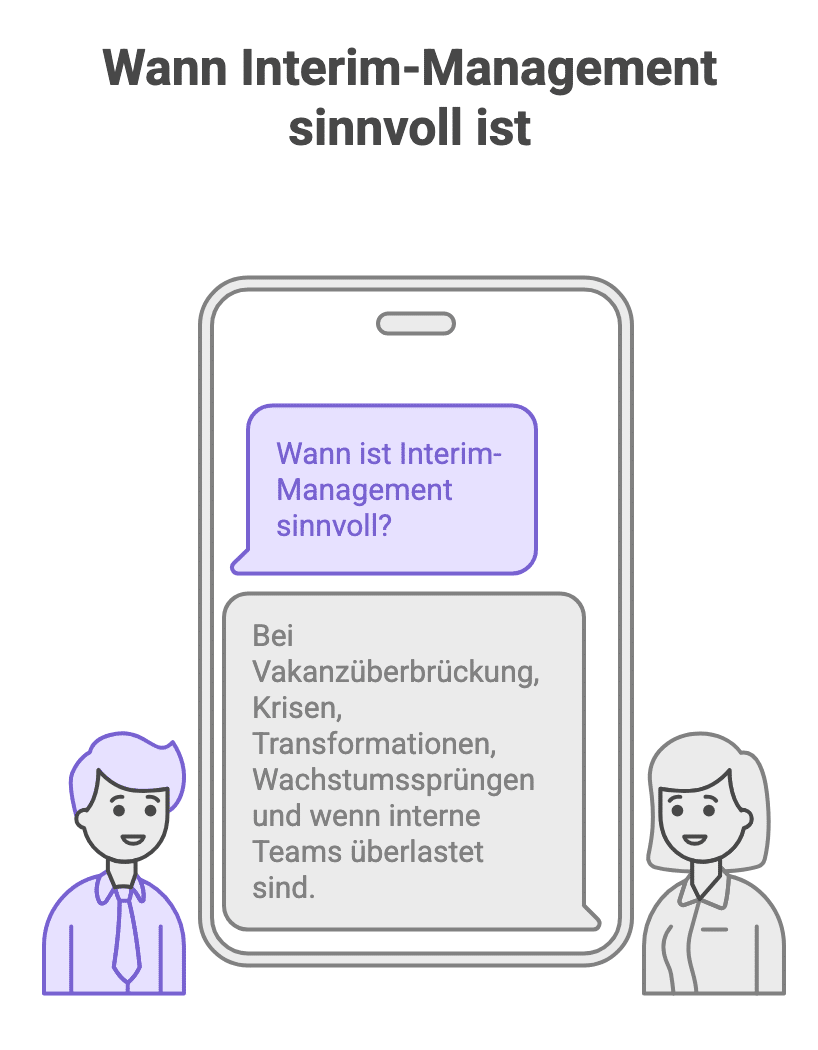
Typical situations in which interim management becomes a stable solution
Bridging vacancies in the event of illness, termination or succession
When a position is vacant, a few weeks without leadership can have a major impact. Interim management closes this gap and ensures that leadership, communication and priorities remain in place.
Crises, restructuring or turnaround phases
Times of crisis place special demands on leadership. Decisions must be made clearly, measures must be implemented consistently and teams must be led through uncertainties. Interim managers are trained to do just that.
Transformation, digitalization or M&A projects
Especially for projects that have a deep impact on the organization, you need someone to lead teams, steer decisions and keep an eye on the many dependencies. Interim management offers reliability and structure here.
Growth leaps and new business areas
When companies grow, structures quickly reach their limits. Interim managers set up new processes, create roles and guide teams through change.
When internal teams are overloaded or lack specialized expertise
Many companies are working to capacity in their day-to-day business. There is often a lack of time or expertise for special situations. Interim management bridges this gap immediately.
What an interim manager does – and why it’s more than just consulting
Taking responsibility instead of just making recommendations
Consulting shows the way. Interim management takes them. An interim manager makes decisions, leads teams and is responsible for results. He does what an internal manager would do – only faster and with a lot of experience from other companies.
Management, control and implementation directly within the company
An interim manager takes over meetings, prioritizes tasks, moderates conflicts and gets projects moving again. They are present, approachable and take on a real mandate.
An objective view from the outside without internal dependencies
External managers have no history in the company. This enables clear decisions and an honest view of challenges that often only become apparent internally at a late stage.
Fast effectiveness without lengthy onboarding
Interim managers are used to jumping into new situations. They quickly identify the most important levers and initiate measures that have an impact.
Roles that we take on in interim management
- Interim CEO / Management
- Interim COO / Operations Management
- Interim CFO / Financial Management
- Interim Sales Management / Commercial Leadership
- Interim project management / program management
- Divisional management in HR, IT, Product, Production or Operations
Our solution: Interim management with clear control and demonstrable impact
A central point of contact for every management role
You don’t have to coordinate different service providers. We take on the role holistically and bring in additional experts if required – for example for finance, HR, operations, transformation or project management.
Access to a network of experienced specialists
If additional expertise is required, we provide it. This gives you a complete set of skills without having to manage multiple partners.
Temporary management – with a mandate, responsibility and clear goals
We take on the role completely: Decisions, communication, leadership, structure and results.
Discharge for management and shareholders
Interim management provides you with space for strategic issues and ensures that the operational business continues to run smoothly.
Which problems we solve particularly frequently in interim management
- Lack of leadership or decision-making ability
- Stagnating projects
- Excessive demands in growth or crisis phases
- Conflicts in the management team
- Unclear responsibilities
Your benefits from professional interim management
- Immediate relief in the lead
- Clear structure and tempo
- Objective view from the outside
- Flexible and predictable support
Real implementation – not theoretical recommendations
Interim management vs. traditional consulting
Consulting provides analyses and concepts.
Interim management delivers leadership and results.
That is the decisive difference.


Why li2pps?
Choose us and benefit from our customized full-service approach to your product based on your individual needs, because we understand that every challenge is unique.
Low use of resources for maximum effect
Pragmatic and efficient problem solving
Customized and individual implementation
Creative marketing strategies with well-founded market analyses
Strong international network of experts
Full-service approach, from the idea to implementation and support.
FAQ
Our FAQ section offers you valuable insights into our services and working methods. Here you will find answers to frequently asked questions. Transparency is important to us – discover the information that will help you make the best decision for your company.
1. what exactly is discussed in the initial consultation?
In the initial meeting, we would like to better understand your current situation, goals and challenges in product and marketing management. Among other things, this involves
- Your existing products or services
- Your target groups and market positioning
- Previous marketing measures and their results
- Your strategic and operational goals
- Expectations of a possible collaboration
The meeting serves to get to know each other and forms the basis for an individual consulting concept. It is, of course, non-binding.
2. what information is required so that a binding offer can be prepared?
We need a few basic details to provide you with an accurate and binding offer:
- A brief description of your company and what you offer
- If available, information on your current product and marketing strategy
- Your specific goals and challenges (e.g. which target markets, target groups, companies, visibility, market awareness)
- The desired scope of services and focus (e.g. consulting, strategy development, implementation)
- Time frame and budget
With this information, we can realistically estimate the project costs and prepare a customized offer.
3. what is the typical project duration?
The duration of a project depends heavily on its scope and complexity. As a rule, our projects last between 4 weeks and 6 months.
- Short projects such as workshops, analyses, raising awareness, etc. : a few weeks
- Strategic projects or market launches: several months
At the beginning, we work with you to define a clear roadmap with realistic time frames and milestones.
4. do you also work with existing agencies or internal teams?
Yes, definitely. In fact, close cooperation with your internal teams or existing agencies is very important to us. We see ourselves as a complement, not a substitute.
Whether it’s a matter of strategic coordination, operational implementation or the further development of existing measures: we integrate ourselves flexibly into your existing structures and bring in fresh impetus from outside. The goal is always efficient, goal-oriented cooperation at eye level.
5 What does a consultation cost and how is it billed?
The costs depend on the scope, duration and individual service requirements of your project. As a rule, we offer three billing models:
- Daily rate for selective services, workshops or project-related consulting
- Package deals for clearly defined projects with a fixed scope of services
- Monthly retainers for continuous, flexible support over a longer period of time
You will of course receive a transparent, binding offer in advance with no hidden costs.